
MIB Smithy
AGENT-CAPABILITIES Statements
AGENT-CAPABILITIES statements are used by manufacturers and implementors of SNMP agents to document (for their users) the features supported by the implementation. This is in contrast to MODULE-COMPLIANCE statements, which, in conjunction with the MAX-ACCESS value of OBJECT-TYPE definitions as well as other descriptive text, document the requirements that an implementation must meet in order to claim compliance with a specification. AGENT-CAPABILITIES statements, when available, allow management applications to tailor their interfaces for individual devices, such as not allowing a user to set an object that is known to be read-only.
AGENT-CAPABILITIES Statements are not supported by COPS-PR-SPPI or SMIv1.
Creating a AGENT-CAPABILITIES Statement
To create an AGENT-CAPABILITIES in MIB Smithy, you must first have created or loaded one or more MIB Modules within the project. Use the Project Tree to select the module in which to create the record -or- one of its records that is the desired parent for the new record. Then, you can either: use Insert →  Capability from the main menu; click on the Add Capability button in the Toolbar; or right-click on the desired parent within the Project Tree and use its New → Capability menu. MIB Smithy will then create the record with a unique, automatically assigned name and subidentifier, and open a page in the Workspace Panel where you can edit its name and other properties.
General Properties
The Capability Name, Status and OID Value properties are all available to be edited from the General Page of the Capability Workspace, which is pictured below.
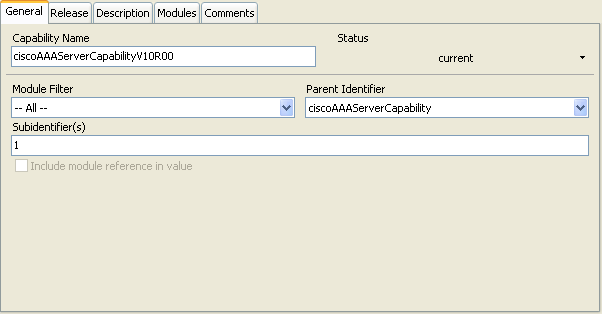
Figure - AGENT-CAPABILITIES Workspace, General Page
Capability Name
Each AGENT-CAPABILITIES statement must be assigned a name. MIB Smithy will automatically assign a name that is unique within the project; however, a user should assign a more suitable name that roughly describes the nature of the statement, such as the vendor, product group, type, or model to which it pertains. The name should be chosen so-as to minimize to the possibility of other OIDs being given the same name for compatibility with tools that do not provide mechanisms for working around name collision.
A valid capability name begins with a lowercase letter and may contain zero or more additional letters or numbers. Hyphens are allowed in SMIv1 provided the name does not end in a hyphen and no two hyphens are adjacent. Hyphens are not allowed in SMIv2 except by way of conversion from SMIv1, which does not have an AGENT-CAPABILITIES equivalent.
This property is unconditionally required.
Status
This property indicates the status of the capability statement with regards to its historic nature. It may take one of only two values: current or obsolete, indicating either that the statement is current, valid and is intended to be an accurate reflection of the agent implementation; or that the statement or product is now obsolete and should not be considered an accurate reflection of the agent implementation.
This property is unconditionally required.
OID Value
This property registers a unique OBJECT IDENTIFIER value that may be used to identify the AGENT-CAPABILITIES statement and the device it is designed to describe. This OID value is used by an agent to identify its self and its capabilities through the sysORID column of sysORTable. This OID value can be used by intelligent management applications to determine the actual capabilities of the agent (versus required or optional features of the MIBs it supports) and to tailor its interactions with the agent or the user accordingly.
This property is unconditionally required.
See Also
Release Property
This property is required.
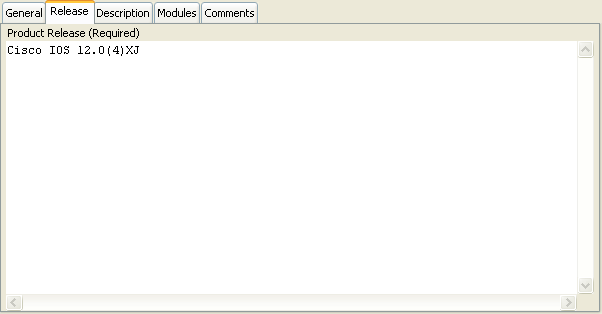
Figure - AGENT-CAPABILITIES Workspace, Release Page
Description Property
This property is unconditionally required.
See Also
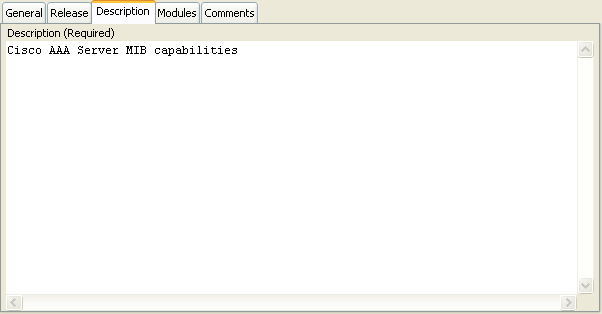
Figure - AGENT-CAPABILITIES Workspace, Description Page
Reference Property
The AGENT-CAPABILITIES's Reference property may be used to provide the reader or implementor a reference to additional supporting documentation that may be of assistance in interpreting the rules or basis for the type. MIB Smithy will apply the same formatting rules to this property as it does for other similar quoted-text fields such as descriptions.
This property is optional.
Modules Property
The Modules property is used to add pseudo-records referencing each of the modules supported by an agent and reflected in described by its AGENT-CAPABILITIES statement. A Conformance Module record is needed to list any supported groups and define any variations on objects or notifications.
This property is optional. However, to be most useful, an AGENT-CAPABILITIES statement should provide an accurate account of the MIBs it supports, and to what level.
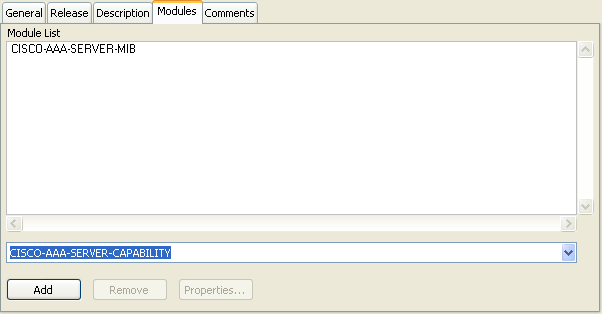
Figure - AGENT-CAPABILITIES Workspace, Modules Page
Comments Property
The Comments Property, which is common to all MIB Smithy records for which ASN.1 is generated (including modules, type assignments, AGENT-CAPABILITIES, etc.), allows you to specify optional comments that are to be associated with the record. Like comments in programming languages, ASN.1 comments are bits of text that allow extra descriptive text to be provided that are discarded by normal parsers. When MIB Smithy generates the module, either when saving or previewing, the comments for a particular record will be generated immediately above the record they are associated with.
See Also
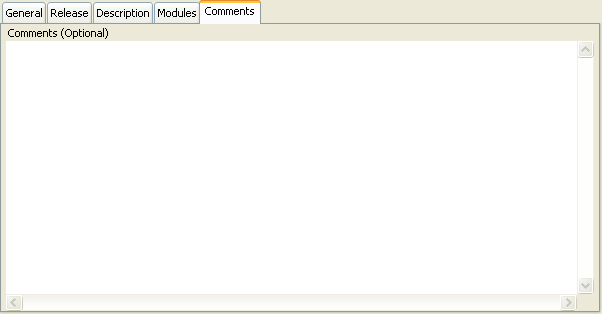
Figure - AGENT-CAPABILITIES Workspace, Comments Page